Short answer
Iron is a chemical element. Steel is a family of alloys made primarily from iron, with controlled amounts of carbon and other elements. Steel’s composition and processing determine how it behaves. 1 2 3
The complication is the word iron. In everyday descriptions of metalwork, it can mean cast iron or wrought iron, which have their own compositions and structures. An “iron gate” is not necessarily made of pure iron. To make a useful comparison with steel, first establish which kind of iron is meant. 4
On this page
At a glance
The table distinguishes iron’s elemental meaning from steel, while flagging how “iron” is used for commercial materials. Cast iron and wrought iron are explained below.
Scroll to compare all columns →
| Question | Iron | Steel |
|---|---|---|
| What does the name identify? | The chemical element Fe. | A family of iron-based alloys. |
| What is it made of? | Chemically pure iron contains only iron; commercial materials called “iron” may contain other substances. | Mainly iron, with carbon and other elements in amounts specified for the grade. |
| Does it have one fixed recipe? | Fe identifies one element. | No. Different grades have different compositions. |
| Does the name predict an object’s behavior? | Only partly; first distinguish pure, cast, and wrought iron. | Only partly; the grade and processing matter. |
| Will a magnet attract it at room temperature? | Yes, metallic iron is magnetic. | Many steels are magnetic; some stainless steels show little attraction. |
| Can it rust? | Yes, in damp air. | Carbon steel can rust; stainless steel resists corrosion but is not immune. |
Sources: identity and rust 1 2; steel classification 5; terminology and material behavior 3 4; corrosion and magnetism 9 10.
What each thing is
Iron
Iron has the chemical symbol Fe and atomic number 26. The element can be present in many different materials, including steel. Calling a material “iron-containing” therefore tells you less than naming the material itself. 1
Two names cause particular confusion:
- Cast iron describes a family of iron alloys generally richer in carbon than ordinary steels. Its structure varies between types. 6
- Traditional wrought iron contains little carbon and characteristic inclusions of slag, nonmetallic material left from production. Working the iron stretches these inclusions into a fibrous pattern. It is not chemically pure iron. 7
Steel
Steel is a material family in which iron is the main element. Carbon content is usually below about 2% by mass, but that is a useful general boundary, not a universal test. The classification standard ISO 4948-1 explicitly allows some steels above it. 5
“Steel” also leaves much unspecified. A producer can supply different grades and process them in different ways; the name alone does not give a complete set of properties. 2 3
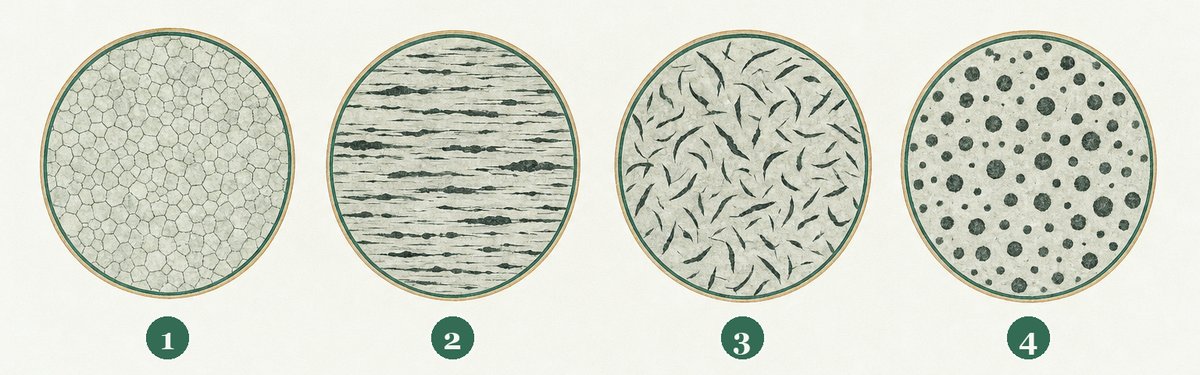
- 1Steel. An iron-based alloy. Its fine internal structure, and so its behavior, depends on the grade and on processing such as heat treatment.
- 2Wrought iron. Little carbon, with inclusions of slag left from production. Working the iron stretches them into a fibrous pattern.
- 3Grey cast iron. Generally richer in carbon than ordinary steels, with flakes of graphite.
- 4Ductile (nodular) iron. A cast iron with rounded graphite particles. It can deform much more before breaking than grey cast iron.
Schematic magnified views, not to scale; structures vary within each material. Illustration: AI-generated for WhatDiffers.
Key differences
Composition and internal structure work together
An alloy’s properties depend on both its ingredients and its microstructure, the small-scale arrangement of its constituents. Two steel samples with the same carbon content can behave differently after different heat treatments. Oxford’s teaching practical illustrates this by comparing differently treated samples containing 0.55% carbon. 3
Heat treatment uses controlled heating and cooling to change a metal’s properties. Depending on the material and treatment, it can soften, harden, or toughen it. That is why “steel is iron with more carbon” cannot, by itself, explain how a finished steel part behaves. 8
Corrosion resistance depends on the type
Ordinary carbon steel can rust when exposed to water and oxygen. The word steel does not promise rust resistance. 2
Stainless steels contain chromium, which helps form a thin protective oxide film on the surface. That film gives corrosion resistance, although particular conditions can still cause corrosion. Stainless steel remains an iron-based material. 9
A precise comparison names the materials and the property being compared: for example, a specified steel grade and a specified cast iron, assessed for hardness, resistance to breaking, or corrosion in a particular environment.
How to tell them apart
For an object you own, start with its documented material specification: the maker’s description, drawings, or a grade marking that can be checked against a specification.
Appearance and heft are weak clues. Iron-based alloys can look similar and have similar densities. A magnet is inconclusive too: iron and many steels attract one, while some stainless steels show little attraction. An unknown material may need specialist analysis. 10
Names can mislead. Historic Environment Scotland notes that people often use “wrought iron” for worked steel. Decorative scrolls do not establish which material was used. 4
Where they overlap
The shared ingredient is iron. Steel and cast iron are both iron-based alloy families, and wrought iron is also predominantly iron. Their names distinguish materials within that wider group. 5 6 7
They also share some observable behavior. Magnetic attraction and rust are possible in multiple members of the group, so neither observation settles the material’s identity. 2 10
Edge cases
Some steels exceed 2% carbon. Carpenter Technology’s Micro-Melt A11 tool steel lists a nominal carbon content of 2.45%. It is a concrete exception to the shortcut that any iron alloy above 2% carbon must be cast iron. 11
Cast irons have different mechanical properties. Grey cast iron contains graphite flakes. Ductile, or nodular, iron has rounded graphite particles and can undergo much more deformation before breaking than grey cast iron. “All cast iron is brittle” erases that distinction. 6
One object can contain several materials. Historic England’s analysis of the gates at Elmore Court identified different materials in different components, including wrought iron, cast iron, and mild steel. 7
Why the distinction exists
The names reflect differences in composition, structure, and how people made and worked the materials. Those differences mattered in workshops before a modern material specification could describe them precisely. Historical ironwork includes both cast and worked forms. 4
Steelmaking also shows why “just add carbon” is an incomplete explanation. The nineteenth-century Bessemer process removed excess carbon and impurities from iron to make steel. Modern production includes routes using iron ore and routes using recycled steel, with the final composition controlled during production. 12 2
Common misconceptions
- “Iron means pure iron.” Establish whether the speaker means the element, cast iron, wrought iron, or metalwork more generally. 4
- “A magnet proves it is iron rather than steel.” Many steels are magnetic. 10
- “Steel does not rust.” Corrosion resistance varies; even stainless steel has limits. 9
- “Steel is always stronger than iron.” The statement leaves the material, processing, and meaning of “stronger” undefined. Compare specified materials under the same kind of test. 3
Examples
Scroll to compare all columns →
| Concrete example | What it shows |
|---|---|
| A sample documented as high-purity Fe | This is close to the elemental meaning of iron. |
| A stainless-steel spoon | An iron-based alloy can resist corrosion because of its composition and protective surface film. |
| The different metal components of the Elmore Court gates | One piece of “ironwork” can include several materials. |
| Micro-Melt A11 tool steel | Carbon content alone does not provide an absolute steel/cast-iron boundary. |
The first two are illustrative examples; the gate analysis and tool-steel composition are documented cases. 1 7 9 11
Sources
Sources consulted October 2, 2026. Numbers beside claims link directly to the supporting material.
- Royal Society of Chemistry — Iron. Elemental identity.
- World Steel Association — What is steel?. Grades, production routes, and rust.
- University of Oxford — Practical 2P2: Steels, updated October 2022. Composition, microstructure, and heat treatment; PDF pages 1–2.
- Historic Environment Scotland, Engine Shed — Iron. Architectural terminology and worked materials.
- ISO 4948-1:1982 — Steels: Classification, ANSI preview. Section 2, PDF page 3.
- TWI — Weldability of materials: cast irons. Cast-iron families and graphite forms.
- Historic England — Analysis of samples taken from the entrance gates at Elmore Court, 1998. Material analysis; PDF pages 2, 4, and 6.
- ASM International, Heat Treating Society — What is heat treating?. Effects of controlled heating and cooling.
- worldstainless — Corrosion properties. Protective surface film and its limitations.
- British Stainless Steel Association — On-site methods for stainless steel grade product sorting. Limits of physical identification clues.
- Carpenter Technology — Micro-Melt A11. Manufacturer’s nominal composition.
- Science History Institute — Bessemer’s Process. Historical process description.