Short answer
A meteoroid is a natural solid body moving through or arriving from interplanetary space. A meteor is the light and related effects made when a solid body enters an atmosphere at high speed; it is a phenomenon, not the rock itself. A meteorite is solid material that survives the meteor phase. The familiar space–sky–ground sequence is useful, but under the International Astronomical Union (IAU) terminology used here, a survivor can already be a meteorite during its unlit fall, before it reaches the ground. 1 2 3
On this page
At a glance
Scroll to compare all columns →
| Question | Meteoroid | Meteor | Meteorite |
|---|---|---|---|
| What is it? | A natural solid body | Light and associated atmospheric effects | Surviving natural solid material |
| Where does the term apply? | In or coming from interplanetary space; it can still describe the incoming body during entry | During high-speed entry into an atmosphere | After the meteor phase, including possible dark flight |
| Must material reach the ground? | No | No | Not yet, under the IAU convention used here |
The table follows the IAU’s technical definitions. NASA’s introductory explanation commonly describes a meteorite as material that reaches the ground. 1 3
What each thing is
A meteoroid is the physical object. The IAU gives a rough size range of 30 micrometers to 1 meter for the general term, while allowing an object of any size that produces a meteor to be called a meteoroid in meteor observations. A meteor is the visible and physical atmospheric event caused by entry. A meteorite is a natural solid survivor after that event. These words identify an object, a phenomenon, and surviving material, respectively. 1
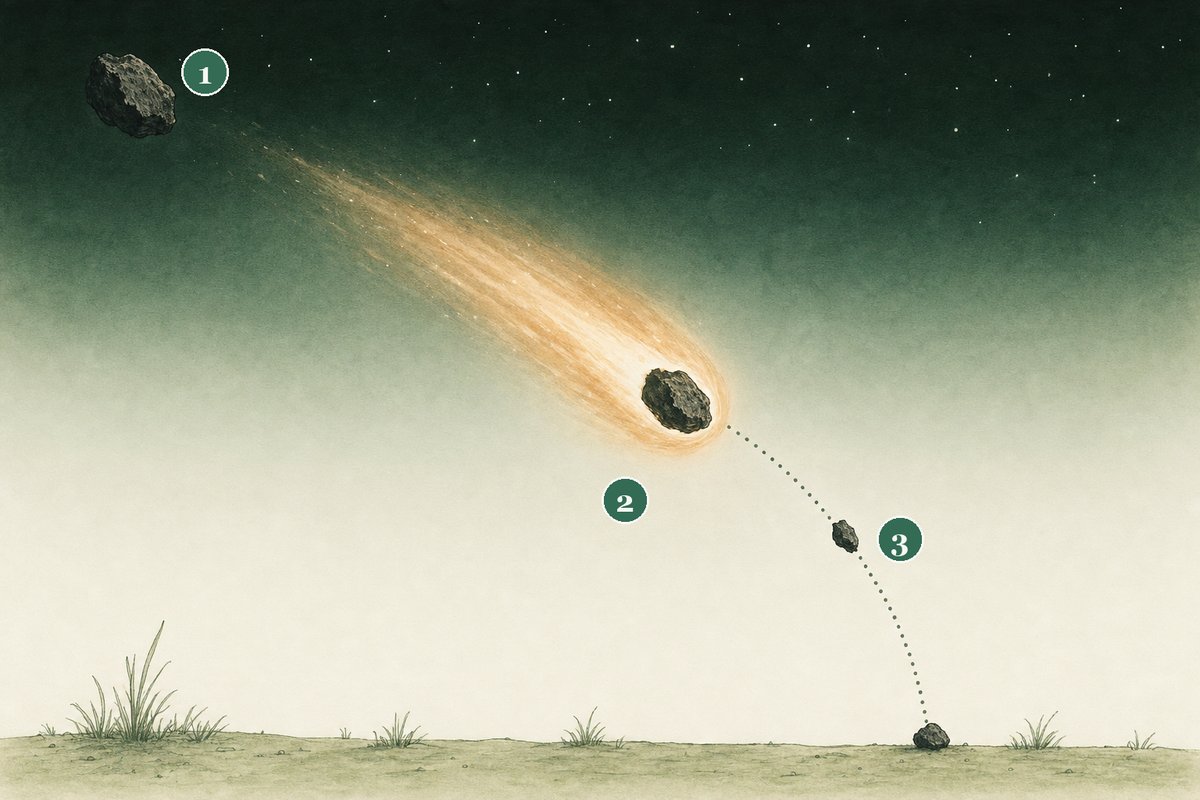
- 1Meteoroid. A natural solid body traveling through or arriving from interplanetary space.
- 2Meteor. The light and related effects produced as the body enters the atmosphere at high speed. The body causes the light and can still exist during it.
- 3Meteorite. Solid material that survives the meteor phase. Under the IAU convention used here, it is already a meteorite during its unlit fall (dark flight), before it reaches the ground.
Schematic, not to scale. Not every meteor leaves a meteorite. Illustration: AI-generated for WhatDiffers.
Key differences
The meteor is not a stage in which the rock literally turns into light: the body causes the light and can still exist during it. The most precise boundary between meteoroid and meteorite here is survival after the meteor phase. The IAU places that transition when ablation stops and the object continues in dark flight; NASA’s simpler public description places the familiar meteorite label at the ground. State which convention you mean when the timing matters. 1 2 3
How to tell them apart
Ask what the sentence points to. A small natural body traveling through space is a meteoroid. A streak or other light effect produced as material enters an atmosphere is a meteor. A recovered piece of surviving natural material is a meteorite. If the question concerns the falling solid after its luminous phase but before landing, specify the IAU convention: it can already be a meteorite. Location alone is therefore a useful first clue, not a complete rule. 1 3
Where they overlap
These terms often describe connected parts of one event. A meteoroid may enter an atmosphere and produce a meteor; material that survives can become a meteorite. The meteor and the entering body coexist during the luminous phase, however, and an incoming body may fragment into several survivors or leave none. The three names are related without being synonyms or requiring a neat one-object, three-stage story. 1 2
Edge cases
The IAU’s meteoroid size limits are conventions, not sharp physical cutoffs. It also allows meteors in sufficiently dense atmospheres beyond Earth. In its terminology, a flash from impact on an airless surface is an impact flash, not a meteor, and foreign material on that surface is not a meteorite. These limits matter when applying an Earth-based shortcut to another world. 1
Why the distinction exists
The vocabulary lets astronomers separate the incoming material, the atmospheric event, and the material that remains. The IAU revised earlier terminology because it found persistent confusion and a mismatch with current knowledge. Its formal definitions make the object–phenomenon boundary and dark-flight case explicit; NASA’s introductory sequence remains a useful simpler explanation for a first encounter with the terms. 1 3
Common misconceptions
A meteor is not a rock floating in space, and a meteorite is not the streak of light. Nor does every meteor leave a recoverable meteorite. Finally, “meteorite” does not always have to wait until touchdown in the IAU convention: surviving material in dark flight already qualifies. 1 2
Examples
Imagine a natural fragment traveling through interplanetary space: it is a meteoroid. On entering an atmosphere at high speed it produces a bright meteor. If part survives after the luminous phase, the IAU calls that solid material a meteorite even during its remaining dark flight. If the material is completely vaporized, there is a meteor but no meteorite. 1 2